Estate Settlement
May 01, 2025
What to Do When Someone Dies in California
Follow this step-by-step guide to navigate legal duties, probate, and estate tasks with clarity and confidence.
Notifying creditors of a death is one of the first steps you need to take as an executor. Here’s how to do it properly.
There are many unknowns when it comes to administering a loved one’s estate, and solving these complexities takes an ample amount of time and energy. But one of the most stressful unknowns as an estate administrator is dealing with unpaid bills or creditor claims. What do you do if you aren’t sure if the deceased had any debts or if you find a potential unpaid bill in some paperwork?
Thankfully, there is a simple solution to dealing with these situations: posting a notice to creditors. In this article, we’ll explain the process of posting a notice, explain how to write one yourself, provide sample notices for you to use and answer common questions about the process.
One of the first steps in the probate process is notifying potential creditors of the deceased’s passing and the administration of their estate. This gives any creditors a chance to bring a claim forward for debts owed to them before the estate is distributed to the beneficiaries. The estate must pay any expenses (funeral costs, court fees, etc.), final tax returns, and any legitimate claims and known debts before distributing funds or assets to the beneficiaries.
Notifying creditors is done by publishing a statement for a certain period of time according to the laws of the province/territory the deceased resided in. In some provinces, such as Ontario, this notice can be posted online. Other provinces, such as Saskatchewan, allow for a statement to be posted either online or in a local newspaper.
Whether or not a notice to creditors must be published will depend on the legislation of the deceased's province or territory. However, a number of provinces do not require a notice to be published. For example, British Columbia’s Wills and Estates Act states that, “The personal representative of a deceased person may publish a notice in the Gazette to creditors and other claimants.” Under Saskatchewan’s The Administration of Estates Act, the personal representative is typically required to publish a notice to creditors, unless a court order is given that removes the requirement—this is only done under specific circumstances.
That said, there are good reasons to post a notice. A notice to creditors limits the timeframe unknown creditors have to bring a claim against the estate. In most cases, a notice limits the claim period to 30 to 120 days.
If a notice is not published, creditors can have up to two years to bring a claim against the estate.
Additionally, if a valid claim does come forward within the statutory time period and the estate has been distributed, the personal representative for the estate may be obligated to pay, regardless of how much funds are left in the estate.

Given the importance of circulating the notice proficiently so all possible creditors can be notified, your state’s laws may require you to publish the notice in a national paper (or online) in addition to posting it in the newspaper in the county of the probate court overseeing the probate of the decedent's estate.
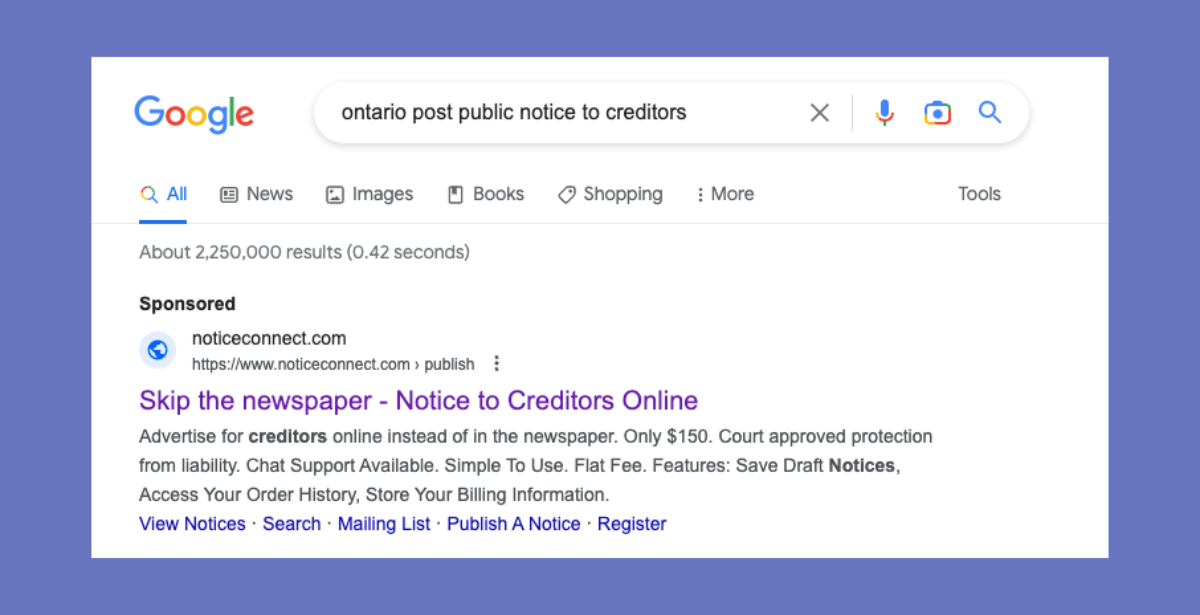
Quick Insight: Doing a quick google search "city of probate+ post public notice" will help you quickly find a public notification service.
Quick Insight: Doing a quick google search "city of probate(or province)+ post public notice" will help you quickly find a public notification service.
Once you have found the proper paper or online platform to publish the notice, make sure to research your province or territory’s statute requirements for preparing it. This legislation will tell you what information you need to include.
To save you some time, here are some general components that you must include in your notice, regardless of the province you reside in:
The name of the deceased (full name, and including any maiden names(s))
The city and region in which the deceased resided
Who is administering the estate and their contact information
The date of death
The claim’s deadline (will vary by province/territory)
Once you have found the proper paper(s) to inform about your notice, make sure to research your state’s statute requirements for preparing a notice. This legislation will tell you what information you need to include.
Below is a quick-access chart to various statutes that describe the requirements for a notice of creditors:
| State | Statue |
| Tennessee | TN Code § 30-2-306 (2021) |
| California | Sec. 9050-9054 |
| Florida | Sec. 733.2121 |
| Texas | Estates Code Ch. 308 |
Once you have a completed draft, be sure to contact the relevant paper(s) to inform them of your desire to publish a notice to creditors. Usually, this will cost around a few hundred dollars, but this expense is considered tax deductible, as it is part of the estate administration process.
Once you have a completed draft, be sure to contact the relevant paper(s) or online notice company to inform them of your desire to publish a notice to creditors. Posting the notice can cost from $150 to a few hundred dollars, depending on where the notice is published. However, this expense is considered tax deductible, as it is part of the estate administration process.
It is crucial that the notice is published for the proper amount of time. In addition, the notice may need to be published more than once—as is the case in Alberta, specifically. In most cases, a publication length of 30 days is sufficient, but double-check the relevant legislation and regulations to make sure you are compliant.
If a claim is brought forward after the notice expires, it is likely to be unenforceable, though some exceptions may exist. Regardless, if the notice was posted properly under the applicable provincial estate laws, the personal representative is typically no longer liable for any claims brought against the estate.
If you have a claim against an estate and you aren’t sure if it is valid, reach out to an estate professional for guidance.
To save you some time (and an inevitable headache) here are some components that you must include in your notice:
To give you a more concrete idea as to what this looks like, below is a sample notice taken from the McKenzie Banner published in Tennessee:
NOTICE TO CREDITORS: Estate of Jane Doe, deceased. Notice is hereby given that on the 27th day of October, 2022, letters testamentary (or of administration as the case may be) in respect of the estate of Jane Doe, who died September 27, 2022 were is- sued to the undersigned by the Juvenile and Probate Court of Lauderdale County, Tennessee. All persons, resident and non-resident, having claims, matured or unmatured, against the estate are required to file the same with the Clerk of the above named Court on or be- fore the earlier of the dates prescribed in (1) or (2) other- wise their claims will be forever barred: (1)(A) Four (4) months from the date of the first publication (or posting, as the case may be) of this notice if the creditor received an actual copy of this no
Once you have a draft notice created, we recommend reviewing it against other public notices in your state. If you feel out of your depth when drafting this document, we recommend getting in touch with an estate professional.
As previously noted, the length of a notice to creditors must remain in the newspaper and will depend on the regulations of the state it is published in. Generally speaking, a notice will typically run anywhere from several days to a few weeks.
However, it is pertinent that you continue to take proactive measures and contact any claimants you may know of while the notice is in publication.
Taking preventative measures like this will mitigate any potential risks of claimants alleging that they were not properly notified, which may slow the probate process considerably.
At ClearEstate, we pride ourselves on offering services that are affordable, custom-tailored to your needs, and easy to understand. If you are feeling overwhelmed as a newly-appointed executor, send us a message. We’re here to make the complex steps of probating an estate simple for you.
Simplify Probate Today
Get expert guidance from our specialists who've helped 10,000+ families.
Book a free consultation