Estate Settlement
May 01, 2025
What to Do When Someone Dies in California
Follow this step-by-step guide to navigate legal duties, probate, and estate tasks with clarity and confidence.
How much should a trustee be paid in California? Read through our comprehensive guide to find answers.
Stepping into the role of a successor trustee entails a substantial commitment of your time, effort and at times - emotional effort. Tasked with the fiduciary responsibility of administering a trust, a trustee must be conversant with state laws, accounting practices, investment strategies, real estate management, and more.
In fulfilling this crucial duty for the deceased, it's essential to understand that the successor trustee's responsibilities don't equate to pro bono work. In fact, the law allows for trustee compensation.
So, what does a successor trustee's compensation look like? The answer to this is multi-faceted.
In our guide, we break down the compensation details as per the California code, while also discussing factors that may influence a deviation from these guidelines. Discover the nuances of trustee compensation in California and gain a better understanding of your entitlements as a successor trustee.
Trustee compensation, while normally outlined within the provisions of the trust, there may be some instances where the trust instrument does not explicitly specify the compensation fee or rate. In this case local laws usually step in to determine what is appropriate.
California legislation states that trustees should receive "reasonable" payment - an ambiguous term which can vary depending on numerous circumstances (California Probate Code §15681).
What constitutes "reasonable" is not specifically defined in the law, making it dependent on the circumstances of each case. This flexibility allows for a case-by-case approach to trustee compensation tailored to the unique factors of each trust.
While it's possible to establish an hourly rate for trustee compensation, this isn't typically the standard practice. More commonly, a percentage of the trust's value is used to determine a fair compensation for a personal trustee.
The nature of the trust and the amount of work required by the trustee are crucial factors in this determination. It's important for all parties involved to agree on these aspects before finalizing the compensation.
Though trustee compensation cannot be easily defined generally, there are a number of factors taken into account to determine how reasonable a trustee’s compensation may be. Let’s review them below.
The size of the trust is a crucial factor. This includes the complexity of the trust, the number of beneficiaries involved, the number of assets that need to be managed, and the total amount of money the trustee will be responsible for managing.
The more complex a trust is, the more a trustee may charge—unless they’re a family member or close friend of the family. It’s important to consider that a trust is a living structure that changes over time, so a trustee’s compensation can change with the trust, too.
In some cases, trustees may believe that they deserve higher compensation. This often happens when the trust structure becomes more complex, and a trustee must spend more time managing a trust.
In this case, a trustee must send at least 60 days advance written notice to each beneficiary (California Probate Code §15686). Trustees are also entitled to compensation for expenditures associated with trust administration (California Probate Code §15684).
While there are no strict rules for trustee compensation, guidelines for executor compensation can serve as a useful reference point. The term "reasonable compensation" is often used in this context. This refers to the average fee for executors in most cases.
For instance, if the average executor fee is 3 percent, it wouldn't be "reasonable" to expect a trustee to be compensated 10 percent of the estate value each year.
While typically only applicable to corporate/professional trustees, trustee compensation is also compared to other similar trustees in comparable areas. If a trustee’s fee is much higher or lower than their competitors without good reason, courts may look on it as unreasonable.
Important Note: Some county courts (e.g. Kern County and Marin County) have specific rules that outline what are prima facie reasonable fees for that county. These should be taken into account.
For example, Kern County’s Court Rule 8.16 indicates, “ A fee of 1% of the fair market value of the ending balance on hand will ordinarily constitute reasonable compensation, prorated if services have been rendered for less than a full year. If compensation higher than 1% of the ending market value is requested, the request must be supported by a detailed description of the services rendered, their necessity, benefit to the estate, expertise required, time expended, and hourly rate.”
Judges can sometimes award additional compensation if the executor has performed duties beyond those normally expected. These could include:
Managing a business: If the deceased owned a business, the executor may need to manage or even sell it, which would go beyond typical executor duties.
Dealing with complicated tax issues: An estate with complex tax matters could require additional work from the executor.
Managing real estate: If the deceased owned multiple properties or properties in other states, the executor may have additional responsibilities.
Trustee fees in California are as varied as the trustees themselves, often influenced by the nature of the trustee's role - professional or non-professional. Understanding this distinction and the costs associated with each can provide clarity when selecting the right trustee for your trust.
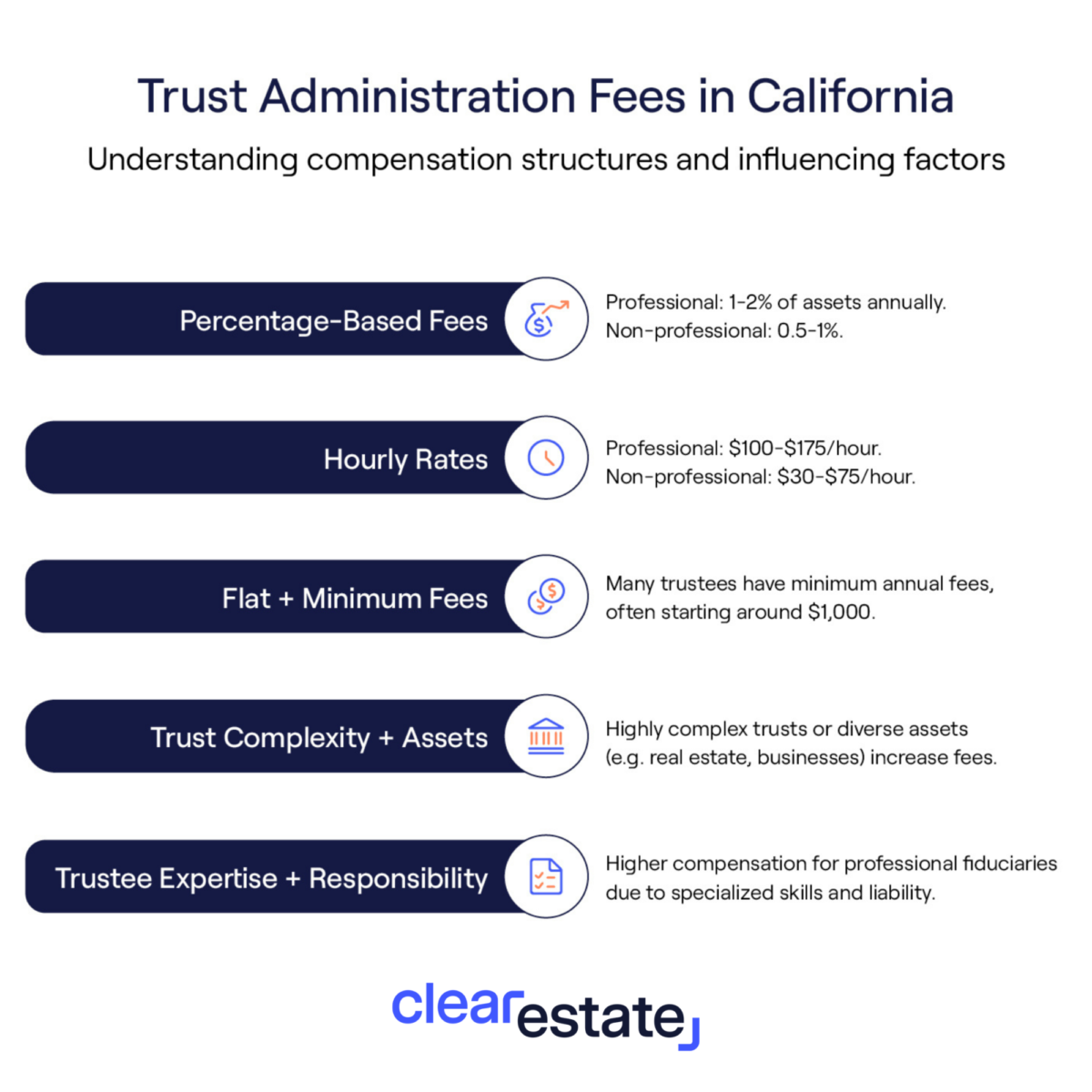
Professional trustees, who bring their legal and financial expertise to the table, tend to have higher fees. Fees for professional trustees are charged annually based on the trust's total asset value. This percentage varies greatly depending on the trustee's expertise and complexity of the trust, but may start at around 1%.
In contrast, non-professional trustees, who are often family members or trusted acquaintances of the trustor, usually operate with lower fees. They typically charge less than professional trustees, which generally means 1% or less of the trust's assets' value annually. On an hourly basis, their fees usually range from $30 to $75. While this is the norm, it's not uncommon for non-professional trustees to waive their compensation entirely, though it's important to remember they're under no legal obligation to do so.
For more professional trustees, a trustee can have higher or lower compensation given to them if they performed their duties with a high level of diligence and care. Keep in mind that while results obtained by the trustee are important, the diligence and efforts of the trustee are underscored more so.
There are multiple factors that go into trustee compensation, which can make answering the question “Is my compensation reasonable?” difficult to answer. Here are some possible scenarios to help you think through this issue more clearly.
Note: For all the scenarios listed below, compensation is ultimately subject to the trust agreement and reviewable for reasonableness by beneficiaries or the court if contested.
A common instance is when a loved one passes away and their spouse or child is named successor trustee. They are now responsible for administering the assets of the trust in a timely manner. The assets included in the trust include the decedent’s principal residence, some minimal investments and some high-value heirlooms. In total, the approximate value of the estate is $750,000.
In this case, while the trustee is permitted compensation, because they are a very close loved one they choose to waive compensation in light of their felt familial duty.
In another scenario, a wealthy businessman passes away in Kern County, and has named a California trust company as trustee. The decedent had a number of items held in the trust, including:
Principal residence - value of $1.5 million
Bank accounts - value of $500,000
Investments - value of $1 million
Shares in his private business - value of $2.5 million
In total, the value of the assets held in trust are $5.5 million.
Under Kern County Court Rules, standard reasonable compensation for trustees is one percent of the final fair market value of the assets managed, unless proof of services is given. In this case, because the trust company will be managing a complex trust, they have chosen to charge a fee of 1.2% of the fair market value of the trust’s ending balance at the end of each year they manage the trust for.
However, in requesting compensation that is higher than normal, the trust company must bring forward proof of their services rendered, including:
A detailed description of their services
Time spent
The necessity of their services
Their expertise
Their billed hourly rate
A final circumstance that trustees or potential trustees should keep in mind is when a close family friend manages a trust that ends up being more complex than anticipated. While it is common for non-professional trustee family members to waive compensation, in these situations, the choice isn’t as clear.
Let’s say your friend has been named successor trustee for your loved one’s trust because they’re a source of financial wisdom for your family. And because the trust is holding some complex assets. These include:
Principal residence - value of $600,000
Bank accounts - value of $500,000
Investments - value of $250,000
Vacation home - value of $450,000
As part of their duties as trustee outlined in the trust indenture, the family friend as trustee is required to manage the sale of both the principal residence and the vacation home. To make matters more complicated, the principal residence is in California and the vacation home is in Colorado. But, they ran into some complications with sales falling through. As such, they needed to keep the properties in good repair for a few years.
In addition, the trustee was also responsible for managing a number of different brokerage accounts during this time.
Because the trustee managed the assets of the trust in an arguably extraordinary manner, they chose to charge a fee of 0.5% of the trusts’ assets on an annual basis—even though they were a close family friend to the decedent. This fee amount also represents that the trustee has some financial knowledge, which prompted their appointment in the first place. While they may not be a professional, their knowledge was relevant to their role as trustee.
According to California Courts Rule 7.776, while determining the compensation of trustees, a court considers the income of the trust estate, the effectiveness of trustee administration, any unusual skills or proficiency of a trustee, the amount of trustee's risk and responsibility, time trustee spends to perform their duties, and many other factors.
If the trust document stipulates an unreasonably low or high amount, the court may allow a larger or smaller compensation, respectively. Specifically, a court may change trustee compensation if the duties of trustees are significantly different from those contemplated when the trust was created, when compensation is unreasonably high or low according to the terms of the trust, and in extraordinary circumstances calling for equitable relief (California Probate Code §15684).
Successor trustees should keep a detailed log of their duties they have performed in line with the trust.
Navigating the complex waters of trustee fees in California can feel like a daunting journey. But you don't have to go it alone. Our team of experienced estate and trust professionals are here to provide personalized guidance tailored to your unique situation.
During our free consultation, we'll take the time to understand your specific circumstances and provide recommendations that align with your trust administration goals. We firmly believe that every trust voyage is unique, and we're committed to providing solutions that are as individual as you are.
Reach out today to book your free consultation. It's a step towards informed trust management, with guidance that's tailored specifically for you.
Trustee fees are generally treated as taxable income to the trustee in the year they were received.
However, legitimate expense reimbursement is not taxed. Therefore, a trustee should keep a detailed record of all trust-related expenses, including travel and any expenditures made in relation to administration of the trust. These expenses should be carefully documented with supporting invoices and checks.
The trustee should also create a trust administration account, typically under a Taxpayer Identification Number obtained specifically for the trust, to receive deposits and pay expenses. This helps avoid commingling trust expenses with personal expenses, which can lead to complications later on and may result in a fee reduction.
When filing the trustee fee - generally, trustee fees are reported as income on the trustee's personal income tax return (Form 1040). If the trust generates income, the trustee may also need to file a separate tax return for the trust using IRS Form 1041, the U.S. Income Tax Return for Estates and Trusts. It's always a good idea to consult with a tax professional to ensure compliance with all tax laws and regulations.
A number of expenses can be covered by the trust. Here are some common examples:
Legal fees: These are fees related to legal services needed for the administration of the trust, such as the preparation of tax returns, defense of the trust in case of legal disputes, or advice on trust management.
Accounting fees: Trusts often require professional accounting services, for tasks such as preparing financial statements or filing tax returns. The costs of these services can be paid by the trust.
Tax obligations: Trusts typically have to pay taxes on income and other gains. The trust can pay these taxes directly.
Investment management fees: If the trust assets are invested, the trust can pay for the costs of managing these investments.
Property expenses: If the trust owns real property, it can pay for expenses related to this property, such as maintenance, insurance, and property taxes.
Distribution expenses: When the trust makes distributions to beneficiaries, there may be associated costs, such as bank fees or costs of transferring property.
Remember, these are just general categories and the specific expenses that a trust can pay for may depend on the terms of the trust agreement, the type of trust, and the applicable laws.
It’s always recommended to consult with a professional advisor when dealing with trust administration to ensure that all actions are in accordance with the law and the terms of the trust.
There is no hard and fast rule when it comes to trustee compensation in California. Instead, compensation is determined to be reasonable based on a number of factors, including the complexity/size of the trust, whether the trustee is a professional, the results of the trustee, and other factors. Court rules for certain California counties can also influence how much a trustee can be compensated.
Yes. If a beneficiary is concerned with the fee a trustee is charging for the management of a trust, they can dispute the fee pursuant to California Probate Code §17200(9). If the dispute is successful, the courts will review the trustee’s fees to determine their reasonableness.
There is also a statute of limitations for these claims beneficiaries should note under California Probate Code §16460. If a beneficiary is provided with a final account showing the trustee’s compensation—and the trustee has not already petitioned the court to approve it—the beneficiary must bring forth a claim within three years of receiving the account.