
Estate Planning
Apr 23, 2026
Should a Family Member Be an Executor? Key Considerations and Alternatives
Family members are the people we trust the most, but are they a good fit to handle our estates when we pass?
Preparing an estate plan and feeling unsure about who to name as executor, or even what the role entails? We explain below.


The turning over of a new year almost always brings reflection in its wake. Maybe you have read that only 15% of Canadians have a proper estate plan in place, so you start planning your estate so your family is not financially and legally burdened by your passing. You might reflect on who you can trust to manage your assets faithfully after you pass — a role known as an executor.
Invariably, some of the first people to come to mind are family. While they might seem like an easy first choice, the role of executor comes with duties and potential family conflict that can burden even the most capable of individuals.
Appointing a family member as executor is not necessarily a bad choice, but you need to know exactly what you’re signing someone up for when you name them as an executor in your will.
Executors in Canada are expected to carry out a number of responsibilities including gathering and securing assets, paying off any bills and taxes owed and distributing the estate’s assets pursuant to the will.
More importantly, an executor is a fiduciary — someone legally required to act in the best interests of the deceased and their beneficiaries, even above their own.
As a fiduciary, an executor has a legal obligation to follow certain duties while fulfilling their role. These duties include:
The duty to act prudently and exercise care
The duty to treat all beneficiaries impartially
The duty not to delegate their authority to another
The duty to prioritize the interests of the beneficiaries above their own
The duty to account to the beneficiaries for their actions
An executor who fails to uphold their duties may be held personally liable.
Case in Point: In Spellman v. Spellman, the court-appointed administrator of a father's estate misappropriated over $368,000 in estate funds by transferring assets to himself and fleeing the province. His sister, an heir to the estate, eventually brought the matter before the Ontario Superior Court of Justice. The court awarded her $178,000 in general damages for the inheritance she should have received, along with $50,000 in additional damages.
Prior to applying for probate, an executor typically fulfills the following responsibilities:
Locating the will and other critical documents: An executor needs to know what their instructions are, which are laid out in the will of the deceased. In addition to finding the will, the executor also needs to locate other documents such as any trust agreements, insurance policies, deeds, and obtain a death certificate.
Arrange funeral and disposition of remains: The executor has the legal authority and responsibility to make arrangements for the funeral and disposition of the deceased’s remains. The executor should follow any known wishes of the deceased, including prepaid funeral arrangements. In the absence of instructions, the executor has discretion to determine the arrangements.
Inventory, secure and value assets: The executor must identify, locate, and secure all assets owned by the deceased.. This includes determining which assets form part of the estate and which pass outside the estate (e.g., jointly held assets or assets with named beneficiaries). The executor must obtain the Fair Market Value of all assets as of the date of death for income tax reporting purposes and, where probate is required, for probate application purposes.
Notifying interested parties: Executors are responsible for notifying relevant parties of the death, including financial institutions, government agencies, utility companies, credit bureaus, and employers. As part of this step, executors also cancel any ongoing subscriptions or paid services the deceased had in place, such as gym memberships or magazine subscriptions.
Notifying beneficiaries: The executor must inform each beneficiary that they are named in the will and provide a general overview of next steps, including expected timelines.
A critical step for an executor is applying for probate. Probate is the legal process of validating the deceased's will and granting the executor authority to act on behalf of the estate.The exact steps and requirements to apply vary depending on the province or territory the deceased resided in, but generally the executor needs to provide the court with the will and a list of inventoried assets. Probate fees may also be owed as part of this process.
Once the executor receives the Grant of Probate, they can begin taking steps to administer the estate.
Not all wills are required to go through probate in Canada. Some assets pass outside the estate and avoid probate. These include jointly held assets with a right of survivorship (such as joint bank accounts or real estate), registered accounts and pensions with named beneficiaries (e.g., RRSPs, RRIFs, TFSAs), and life insurance policies with designated beneficiaries. Because these assets transfer directly to the surviving owner or named beneficiary, they typically do not form part of the probated estate.
With the Grant of Probate in hand, an executor can start administering the estate.
Notifying potential creditors: The executor must publicly notify creditors of the death and their authority over the estate. This typically involves publishing a notice in a local newspaper for a set period, though the specific requirements vary by province and territory. Proper notification protects the executor from personal liability for debts they weren't aware of.
Open an estate bank account: The executor is also required to open an estate bank account to manage estate funds. Financial institutions usually require a copy of the Grant of Probate and a death certificate to open an account.
Liquidate assets: Depending on the terms of the will and the estate's obligations, the executor may need to sell certain assets such as real property, vehicles, or investment portfolios held in the deceased's name, and deposit the proceeds into the estate account. Assets that the will directs to be transferred to a specific beneficiary are not sold.
Pay creditors and debts: Once the creditor notification period has passed, the executor pays all valid claims and outstanding debts, including funeral costs and medical bills.
File outstanding tax returns: The executor must file any outstanding personal tax returns on behalf of the deceased, along with a final return for the year of death. If the estate earns income during administration, the executor must also file an estate income return.
Distribute assets to beneficiaries: Once all debts and taxes are settled, the executor distributes the remaining assets according to the will and provides beneficiaries with a full accounting of the estate's administration.
Close the estate: After all the assets have been distributed, the executor closes the estate bank account and concludes the administration of the estate.
In addition to the above duties, an executor is required to keep detailed records regarding their management and administration of the estate. This includes time spent on estate matters, receipts for expenses such as funeral costs, and a full record of all financial transactions.
These records serve two purposes: they help the executor manage the estate accurately, and they demonstrate to beneficiaries that the executor has fulfilled their fiduciary duties and — if applicable — that their compensation is fair. Beneficiaries have the right to request a detailed accounting at any time, and if a dispute reaches the courts, the executor will be required to provide one.
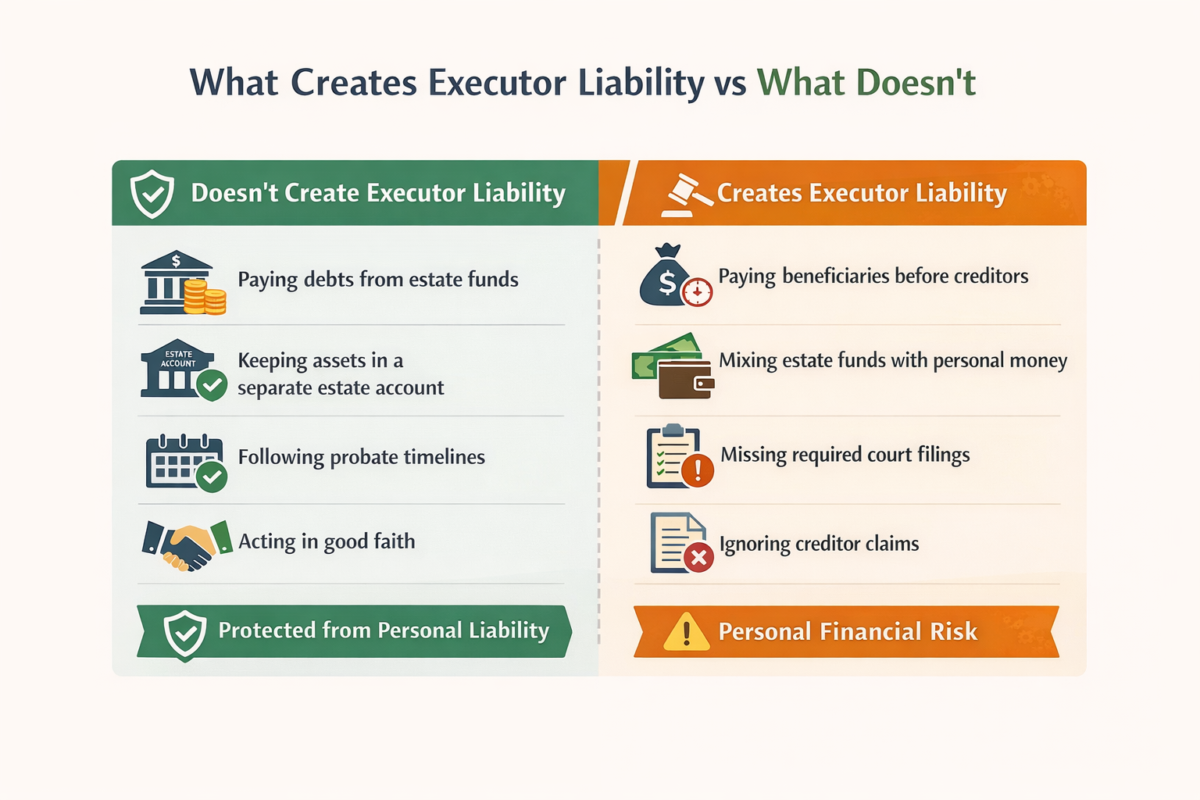
The duties that an executor bears are not for the faint of heart. Even simple estates can take a significant amount of time to administer with proper care. Before deciding on who to appoint as your executor, take note of these common challenges executors face.
Our estate specialists have dealt with many estates over their decades of service in the estate industry. The most common and painful part of executorship they have witnessed? Family drama.
It could be a sentimental item with no monetary value that goes to one sibling and not another. Or a decision about the family home that catches family members off guard. Even though the executor didn't write the will, they often get caught in the crossfire of emotions and grief just for carrying out its instructions.
Canadians that have handled an estate often reflect on the unexpected complexity of their role, both in the time it took to settle the estate and what was required of them. Executors need to navigate financial, legal, and sometimes even interpersonal matters that most people have no prior experience with. It is not uncommon for executors to spend hundreds of hours administering an estate from start to finish. That is time away from their work, their family, and their other obligations.
Acting as an executor does carry a real legal risk. Not fulfilling a fiduciary duty or failing to keep proper accounting records could lead to legal action if a beneficiary believes the executor is not acting in good faith. Even if a lawsuit never materializes, knowing you are legally liable for your actions adds additional stress on executors who are not used to the role.
Traditionally, when families are planning their wills, they choose someone close to them as an executor: An eldest child who appears responsible, or a family friend who is good with numbers. But that is not the only option. Professional executors are individuals or firms who specialize in estate administration, bringing trained expertise and an impartial approach to the process. Below, we compare the two types of executors to help you decide which is the right fit for your estate.
Time commitment: Regardless of whether your executor is a professional or not, expect them to take roughly 12 months or more to administer an estate. While traditional executors who are not trained may take additional time to understand their duties fully, professional executors can act quickly given their expertise.
Skill level: Compared to family and friends, professional executors have a wealth of knowledge, experience and technical expertise.
Cost: Traditional executors are entitled to compensation under Canadian law, though many choose not to claim it, viewing the role as an act of respect or familial obligation. Professional executors charge fees for their services, typically ranging from 3% to 5% of the estate's gross value depending on a few factors.
Conflict resolution abilities: Traditional executors are often already part of the family dynamic, which means taking on the role can strain even the strongest relationships. Professional executors sit outside the family and can manage disputes impartially, without the emotional ties that make conflict harder to navigate.
Suitability: For simple estates that have bank accounts and some simple investments, appointing a family member or friend as executor can be a reasonable decision. However, estates that have complex assets (e.g. blended families, multiple properties, business interests) may be better suited with a certified professional at the helm.
Asking someone to act for you after your passing is a mark of honor. But it is also a task that not everyone is suited for. Between the complex family dynamics, legal accountability, and hours of administrative work, being an executor is a duty that can quickly turn into a burden — one that grieving family members or friends don't need to carry.
But there is another option. Clear Estate offers end-to-end estate services, from planning your estate to administering it after you’re gone. With tools like our digital vault for secure document storage and our all-in-one dashboard, you have complete transparency at every stage of the process.
Want to leave a legacy with less stress and learn how we can help you make the right choice in who to appoint as executor? Book a free, no pressure consultation with one of our experts to find out how.
Yes. If they choose not to accept the role prior to the testator (will maker) passing, the process is relatively simple. However, if they decline before taking any action on the estate, the process is straightforward. However, once they've begun acting as an executor, stepping down requires court approval.
On average, it takes roughly 12 months or more for an executor to fulfill all their duties. This varies from estate to estate depending on the complexity.
Yes. It is common for an executor to be a beneficiary in cases where a spouse is appointed as an executor, for example. That said, an executor must ensure they act with extra care and impartiality if they are one of multiple beneficiaries due to the inherent conflict of interest
Professional executors always charge for their services, usually as a percentage of the estate's value. Family members or friends who act as executors are entitled to compensation — particularly if the will provides for it — but many choose to waive it, viewing the role as a familial obligation.
A professional executor is worth considering when an estate is high in value or involves complex assets such as business interests or property in multiple jurisdictions. It may also be the right choice when family dynamics could make the role difficult for a friend or family member to take on.


 Secure Your Legacy
Get your free 12-step Estate Planning checklist now. 89% of readers complete their estate plan within 3 months of using our guide.
Instantly Access NowRelated articles

Estate Planning
Apr 23, 2026
Should a Family Member Be an Executor? Key Considerations and Alternatives
Family members are the people we trust the most, but are they a good fit to handle our estates when we pass?

Estate Planning
Mar 26, 2026
Bank Executor Services Versus Independent Executors: Understanding Your Executor Options
Want to work with a corporate executor but not sure where to start? ClearEstate compares professional executors from banks and other institutions.

Estate Planning
Mar 05, 2026
A Will Is Not an Estate Plan
Why this distinction matters more than most Canadians—and their advisors—realize