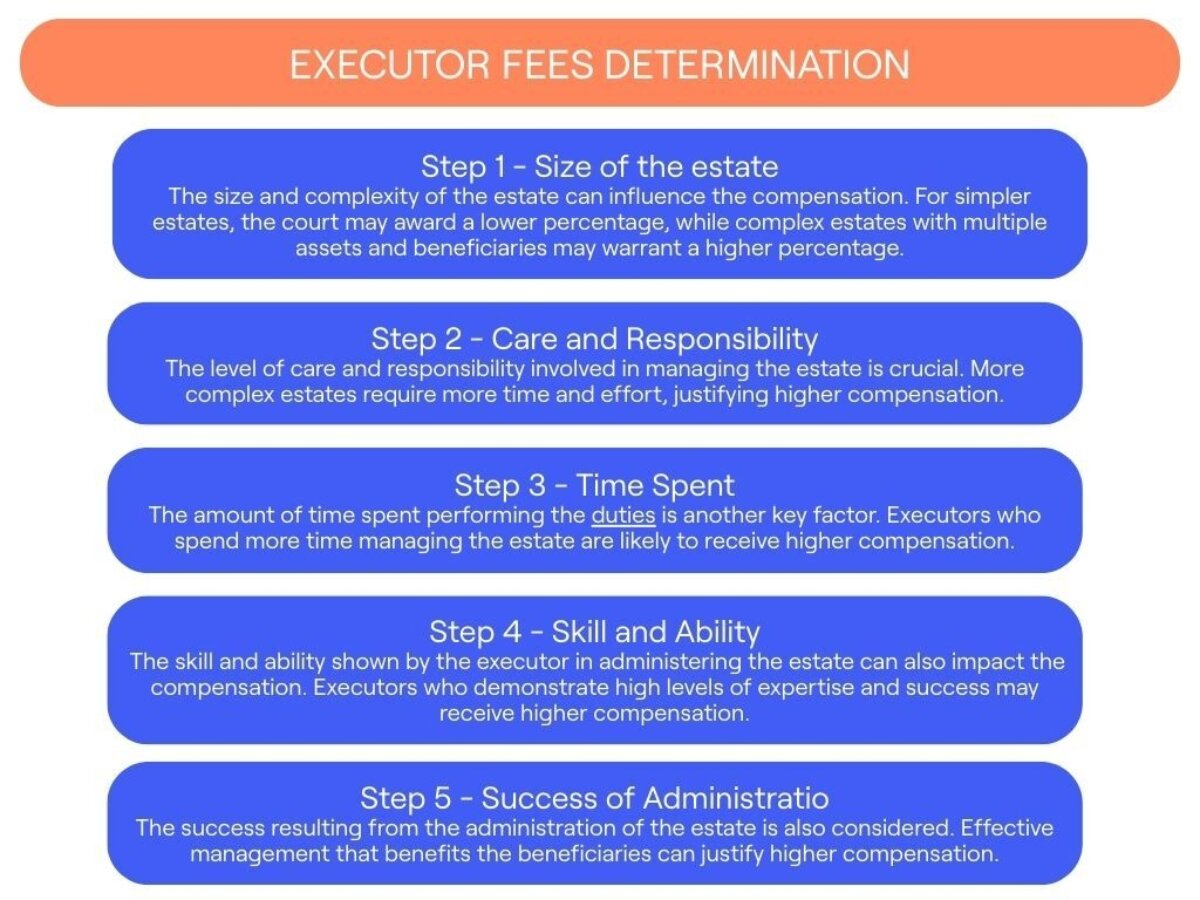
Executor fees are guidelines, not fixed rates
Keep in mind that this 5% fee is a general guideline rather than a fixed rate.
According to Section 61(1)of the Trustee Act, a trustee is entitled to "such fair and reasonable allowance for the care, pains, trouble, and time expended in administering the estate" as may be allowed by a judge of the Superior Court of Justice.
Although there is a practice of awarding estate trustees compensation based on a percentage of the following amounts:
Capital receipts – amounts that add to the estate’s principal (e.g., proceeds from selling the house or investments)
Capital disbursements – payments out of principal (e.g., funeral expenses, paying debts, specific bequests from the will)
Income receipts – income earned during administration (e.g., interest, dividends, rent).
Income disbursements – expenses chargeable to income (e.g., investment management and bank fees, insurance).
Depending on the complexity of the estate, an executor may also charge up to 0.4% per year for "care and maintenance" as a management fee for the estate.
This practice is not set in stone, and executor compensations are actually made on a case-by-case basis.
For example:
(A) For an estate with only one real estate property, the court may warrant less than a 5% executor compensation, seeing as it is a relatively simple estate.
(B) For a larger estate with multiple beneficiaries around the world, and several properties, a reasonable compensation may be higher than 5% seeing as it is a larger and more complex estate.
As outlined by Ontario's Superior Court of Justice, estate executors in Ontario may charge a compensation of up to 5% of the estate's value.
The logic behind the 5% executor fee is as follows:
- Up to 2.5% on the value of assets or cash received
- Up to 2.5% on the value of assets or cash distributed
For a quick estimation based on the maximum rate, use our executor fee calculator below: