
Estate Planning
Apr 23, 2026
Should a Family Member Be an Executor? Key Considerations and Alternatives
Family members are the people we trust the most, but are they a good fit to handle our estates when we pass?
Estate settlement is brutal. It must be redesigned for Gen Z.


The most complex administrative task of life. It’s like doing your parents’ taxes without them present. Worse than divorce.
This is how educated professionals close to me have described the challenges of estate planning and settlement, the latter phase in particular. If accounting, law and finance experts are quietly terrified at the prospect of being named an estate executor, imagine the stress and harm to productivity experienced by those with no expertise in related fields.
As an estimated $1 trillion so-called Great Wealth Transfer (GWT) from Canadian Baby Boomers to their beneficiaries is underway, it’s urgent that we recognize the historical burden of estate administration, and how growing inequality amid this generational shift presents unforeseen challenges at an unprecedented scale.
According to a poll conducted by Maru Public Opinion in 2022, over 70% of Canadians will be named as either a beneficiary of an estate or its executor, the trustee appointed to manage and ultimately liquidate a person’s assets once they’ve passed away. It is conceivable then that about 10 million Gen Z and millennial Canadians will find themselves in the near future relying on various overburdened institutions, public and private, to manage family estates—when we use the term estate settlement, this process applies to any person who dies, even those with more debt than assets.
An estate’s value does not correlate to its complexity. Even middle-class estates can be complex: a small corporation, a cottage or timeshare in another jurisdiction, pension plans, private investments or cryptocurrency. Even if modest, settlement is inevitable without beneficiaries renouncing the estate and its assets.
For every Canadian that dies, a loved one is usually tasked with settling their affairs over the course of 18 months, on average.
Estate settlement begins most inconveniently in the immediate wake of a death, when grief is acute. An executor begins roughly 200 hours of administrative tasks: banks, government forms, taxes, asset location, beneficiary communications and redundant authentication loops.
Having a will is a good start but, as we say, it is only the tip of the iceberg.
While Canadians are increasingly aware about the benefits of estate planning—inheritances, business succession planning, funeral pre-planning, and so on—most are woefully unaware of the implications of estate settlement. The poll found half (50%) of those appointed as an estate executor said settlement was among the most difficult challenges of their lives.
Most Canadians experience an estate settlement process at least once but nearly all estate-centric financial services are mostly unavailable to middle income families, and completely unavailable to those with modest income and assets.
Yet the process remains for all, essentially unchanged since notaries in French Canada began collecting records in the mid-17th century.
Enduring cultural taboos surrounding death is, ultimately, the root cause of centuries of injustice related to intergenerational wealth transfers. Now that we are on the cusp of the largest ever generational transfer, there is an opportunity to heed historical lessons.
Literature is replete with tales of family rivalry and contentious litigation following a death. Charles Dickens explored the theme of institutional inertia in Bleak House, rumored to be inspired by the real Thellusson v. Woodford estate case, which was litigated for over six decades. In Agatha Christie’s After the Funeral, the mere reading of a will triggers murder and mistrust, placing the executor at the heart of the family turmoil until Inspector Hercule Poirot uncovers the truth.
In these narratives, the executor is often cast in a suspicious light, precisely due to their control over wealth access. Yet, these characters are frequently vindicated, serving instead as narrative red herrings and, more broadly, as symbols of the malaise that plagues the estate settlement technocracy.
“Death is not the end,” said the Civil War veteran and journalist Ambrose Bierce. “There remains the litigation over the estate.”
The 18th century Swiss philosopher and theologian Johann Kaspar Lavater warned: “Never say you know a man until you have divided an inheritance with him.”
Executor choices have been inflaming family dynamics to the point of litigation for centuries. The modern trend of naming co-executors often doesn’t ease tension as expected (more signatures, vetoes and delays). Lay executors often don’t realize they can face personal liability for errors: missed tax or debt payments, reckless disbursements, hidden creditor claims or mishandled assets.
To avoid this legal minefield, the services that are available to most people are through a patchwork of professional offices. After half a decade in this space, it’s only become more obvious that the system remains not only fragmented but broken for most families. And as a former lawyer, I worry about the capacity of our courts to manage the coming surge in estate litigation.
An emerging category of professionals can help offset the administrative crisis that may be triggered by the GWT, the Trust and Estate Practitioner (TEP). There are now nearly 4,000 of them certified in Canada by the Society of Trust and Estate Practitioners (STEP) but demand for their services may soon to exceed the supply.
A neutral professional reduces perceived favouritism, standardizes communications and documents each step of the process to minimize disputes. That neutrality is a pressure-release valve: it reduces suspicion among beneficiaries , manages expectations and helps keep families out of court. The TEP’s job is not to take sides but to de-escalate, turning potential litigation into transparent process and routine reporting. Families get information at a predictable cadence, institutions get clean data and all involved move on with their lives sooner.
The common do-it-yourself or professional patchwork settlement models experienced by the vast majority of Canadians postpones administrative heavy lifting until after death; this is why some people in the industry refer to the “scavenger hunt”, because very few estates are thoroughly organized with settlement in mind. A more efficient, technology-based vision of the estate settlement process is unfortunately experienced by a mere 1% of Canadians polled in the aforementioned exercise, most often families with a high net worth.
Avoiding a year and a half of complex, often emotionally triggering administrative tasks in the wake of the death of a loved one remains regrettably a luxury service.
The gap between richer and poorer is widening again. To help mitigate generational estate chaos and a further decline in Canadian productivity, it is incumbent upon both governments and financial institutions to innovate much faster; using readily available technology to avoid useless data entry and re-entry, and moving paperwork upstream so grieving families aren’t ambushed at the worst possible time.


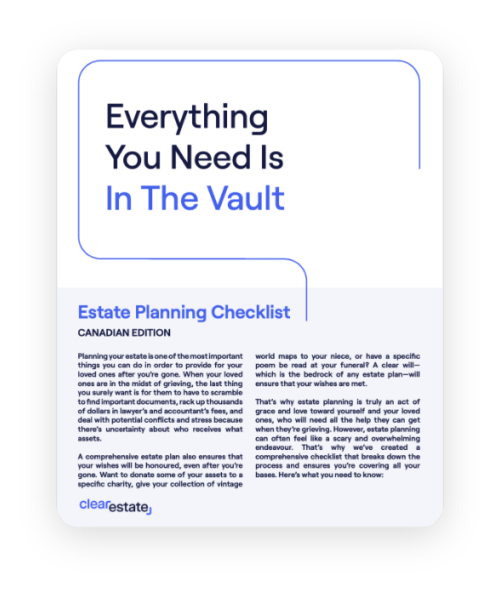 Secure Your Legacy
Get your free 12-step Estate Planning checklist now. 89% of readers complete their estate plan within 3 months of using our guide.
Instantly Access NowRelated articles

Estate Planning
Apr 23, 2026
Should a Family Member Be an Executor? Key Considerations and Alternatives
Family members are the people we trust the most, but are they a good fit to handle our estates when we pass?

Estate Planning
Mar 26, 2026
Bank Executor Services Versus Independent Executors: Understanding Your Executor Options
Want to work with a corporate executor but not sure where to start? ClearEstate compares professional executors from banks and other institutions.

Estate Planning
Mar 05, 2026
A Will Is Not an Estate Plan
Why this distinction matters more than most Canadians—and their advisors—realize