Estate Planning
Apr 23, 2026
Should a Family Member Be an Executor? Key Considerations and Alternatives
Family members are the people we trust the most, but are they a good fit to handle our estates when we pass?
Why this distinction matters more than most Canadians—and their advisors—realize


Quick question: does a typical Will include an estate plan?
In a national poll of 3,048 Canadian adults that ClearEstate commissioned in 2026, 56% said yes.
It doesn't.
Overall, 81% of the people we surveyed showed at least some confusion between the two. That confusion is one of the biggest reasons estate settlement ends up slower, costlier and more stressful than it needs to be. I've lived the consequences myself, so let me explain the difference, and give you a checklist for what a complete estate plan in Canada should include.
A Will answers two questions: who gets what, and who's in charge.
An estate plan answers everything else. Who makes decisions if you're alive but can't make them yourself? Where are the accounts? What happens to the RRSP, the life insurance, the business, the passwords? What if your executor dies before you do?Continued below ↓
We asked Canadians what is usually included in a Will. Here's what they picked, and where each item actually lives.
Item | Said it's usually in a Will | Where it actually lives |
|---|---|---|
Beneficiary designations | 69% | Your estate's beneficiaries are named in your Will; designations on RRSPs, TFSAs and life insurance are usually made with the institution |
Executor | 66% | In your Will (yet a third of Canadians didn't pick it) |
An estate plan | 56% | Around your Will, not inside it |
Funeral or burial wishes | 55% | Often noted in a Will, but best shared separately, for example in a letter of wishes |
Powers of attorney | 51% | Separate documents (a protection mandate in Quebec) |
Trusts | 45% | Sometimes. A testamentary trust is written into a Will; others, like family or alter ego trusts, are set up separately |
Life insurance | 37% | A separate contract with its own named beneficiary |
Healthcare directives | 34% | A separate document, such as a power of attorney for personal care |
Tax or probate plan | 23% | Separate planning, often with an advisor or accountant |
Digital asset information | 19% | Separate. Never put passwords in a Will, which can become a public document once probated |
Here's what surprised me most. Canadians are confident: 57% say they're informed about estate planning. But only 21% have a completed estate plan, and 60% have none at all. Even among Canadians 65 and older, 65% don't have one done.
That gap isn't carelessness. It's a vocabulary problem. People sign a Will, hear the word "estate" in the room, and walk out believing everything is covered.
I want to be clear: a Will is essential. Without one, provincial law decides who inherits and who administers your estate, and without one, someone has to apply to be appointed administrator, which usually takes longer and costs more. A good Will names your executor (a liquidator in Quebec), sets out who receives what, names who you’d like to care for your minor children and records your intentions.
But a Will is static. It's high-level. And it says almost nothing about how any of it gets done. It won't tell your executor which bank holds your accounts, how to log into them, what happens to property you own jointly, or which assets pass outside the estate through a beneficiary designation. Those gaps land on your family.
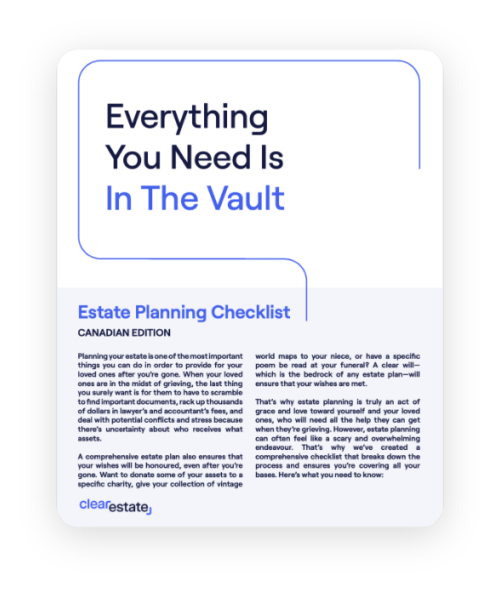
Use this as your estate planning checklist. If you can tick every line, you have an estate plan. If you can only tick the first one, you have a Will.
The point of all this is continuity. Nobody should have to reconstruct your financial life while they're grieving you.
For province-specific detail, see our Ontario estate planning guide and our explainer on what a power of attorney is.
Settlement is where an incomplete plan shows up. ClearEstate's own client data shows uncontested estate settlements typically take 12 to 18 months, and that's when things go smoothly.
Now add the missing pieces. Among Canadians who haven't appointed a professional executor, 44% aren't sure how their executor would get to their latest information on assets, debts, accounts, deeds and passwords. Every gap becomes a phone call, a letter or a trip to a bank branch. Slower. Costlier. Harder on everyone.Here's the encouraging part of the poll. Once people start, they keep going.
54% of Canadians currently working on a Will plan to complete or update their estate plan within a year, compared with 18% of those with no Will.
Among those already working on an estate plan, it's 59%.
41% of people who have served as an executor plan to complete or update their own plan within a year, versus 26% of those who haven't. Seeing it up close changes people.
So don't wait for the perfect moment. Start with one line on the checklist above.
Advisors are excellent at building wealth. The harder part is making sure it transfers the way the client intends.
The poll gives you an easy opening. Ask a client: "Does a typical Will include an estate plan?" More than half will say yes. That answer is the start of a better conversation, not the end of one.When my mother died, I was her executor. I'm an only child and was the sole residual beneficiary, so on paper it should have been simple. She had a Will. She didn't have a complete plan.
What followed was more than two years of avoidable stress and administrative work. That experience is the reason I co-founded ClearEstate.
A Will protects intentions. An estate plan protects people.
Estate planning isn't only for the wealthy, and it doesn't end when you sign your Will. A strong plan is clear, kept up to date and built with settlement in mind, so the people you leave behind can spend their energy on each other instead of on paperwork.
If you have a Will, you've already started. That puts you in the group most likely to finish.
No. A Will is one document within an estate plan. It names your executor and says who receives your assets. An estate plan also covers powers of attorney, healthcare directives, beneficiary designations, an asset inventory, tax planning and instructions for your executor.
A complete estate plan usually includes a Will, powers of attorney for property and for personal care (in Quebec, one protection mandate can cover both), up-to-date beneficiary designations, an inventory of assets and debts, a tax plan, any trusts you need, a letter of wishes, and instructions for digital assets and documents.
A Will takes effect at death. A power of attorney only works while you’re alive. It lets someone you choose make financial decisions for you, and personal care decisions if you become unable to make them yourself. Depending on how it’s written, a power of attorney for property can start right away or only if you lose capacity. Your attorney’s authority ends at your death, and your executor’s begins.
A Will is the essential first step, and for a very simple estate it covers the most important decisions. Even then, powers of attorney and up-to-date beneficiary designations protect you during your lifetime and make sure your assets pass the way you intend, without conflicting with your Will.
Review it after any major life event, such as marriage or a new common-law relationship, separation or divorce, a birth or death, a move to another province or a significant change in assets. Otherwise, a review every few years is a good habit.


 Secure Your Legacy
Get your free 12-step Estate Planning checklist now. 89% of readers complete their estate plan within 3 months of using our guide.
Instantly Access NowRelated articles

Estate Planning
Apr 23, 2026
Should a Family Member Be an Executor? Key Considerations and Alternatives
Family members are the people we trust the most, but are they a good fit to handle our estates when we pass?

Estate Planning
Mar 26, 2026
Bank Executor Services Versus Independent Executors: Understanding Your Executor Options
Want to work with a corporate executor but not sure where to start? ClearEstate compares professional executors from banks and other institutions.

Estate Planning
Feb 13, 2026
Executor of a Will: What the Role Involves and When to Seek Professional Help
Preparing an estate plan and feeling unsure about who to name as executor, or even what the role entails? We explain below.